
Brandon Russell
Solutions Marketing Leader, Trane Technologies.

David Moran
Senior Product Manager, Ultra-Low Storage, Trane Technologies.
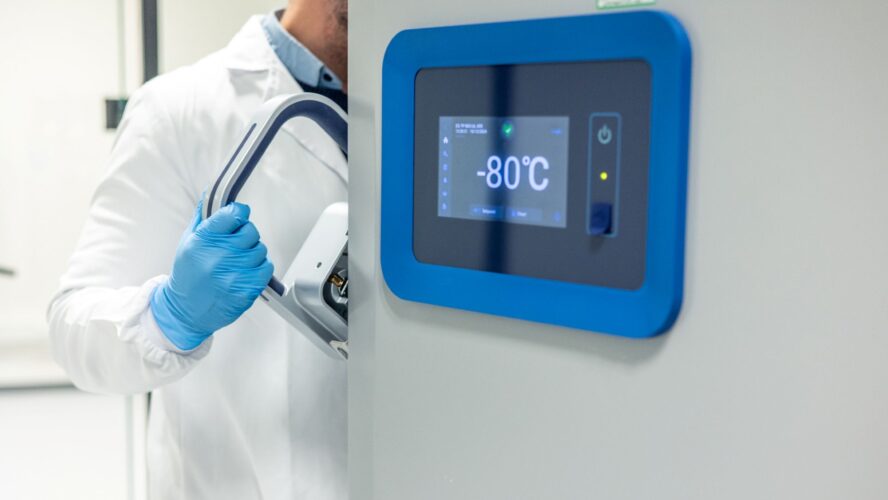
Ultra-low temperature (ULT) storage is essential, directly influencing research outcomes, manufacturing efficiency and the safe preservation of biological materials.
Q: What organisations typically face ULT storage challenges?
Any organisation using ULT freezers for applications other than stable, long-term storage will face challenges with cold-wall technology. In life sciences, biotech companies, contract development and manufacturing organisations (CDMOs), academic research labs and pharmaceutical manufacturers store materials at ultra-low temperatures and rely on cold-wall ULTs for that purpose. These organisations often store irreplaceable patient samples, sensitive biologics or high-value research materials, sometimes decades of research. When your work changes people’s lives for the better, safeguarding it is critical.
Q: What challenges do your customers face?
Access is a major limitation of traditional cold-wall ULT technology. These systems were designed for long-term storage of conditioned material with minimal, infrequent access requirements — and they’re good at meeting that need. But what we’re seeing more — as the complexity of therapies evolves — is the use of cold wall ULTs in applications that require unit access 5-10 times per day and the storage of unconditioned material that needs to be brought down to ultra-low temperatures quickly and stored. Conventional ULTs weren’t designed to support these workflows and introduce significant risk.
Q: How is forced-air cooling different?
Forced-air technology actively circulates conditioned air throughout the chamber, creating a more uniform and stable environment. The system drives cold air across the stored material to reach target temperatures faster while maintaining conditions across the entire unit by consistently removing heat from the chamber. FARRAR® CYCLONE™, the first forced-air convection freeze/store chamber, uses this principle to provide a solution to address the specific challenges biopharma companies experience when driving their workflows through traditional cold wall ULTs.
CYCLONE protects samples from temperature excursions while combining dual-purpose freeze-and- store capability in a single unit. It also prevents frost accumulation on walls, doors, and gaskets, common in cold-wall ULTs. Serviceability is also a challenge. Cold-wall systems usually require the unit to be taken offline and samples moved during thawing, cleaning and recalibration. CYCLONE™ has a quick-change refrigeration system, which can be swapped without taking a unit out of service, without wiring or brazing, decreasing service complexity.
CYCLONE protects samples from temperature excursions while combining dual-purpose freeze-and- store capability in a single unit
Q: What should organisations consider when selecting cold storage solutions?
Flexibility and scalability. Biopharma organisations often don’t know what materials they’ll be storing in the future, especially contract manufacturers with multiple clients. Systems that can operate across a wider temperature range, from –20°C to –80°C, that can both freeze and store materials, and that accept a wide range of bottles and bags, provide more operational flexibility.
